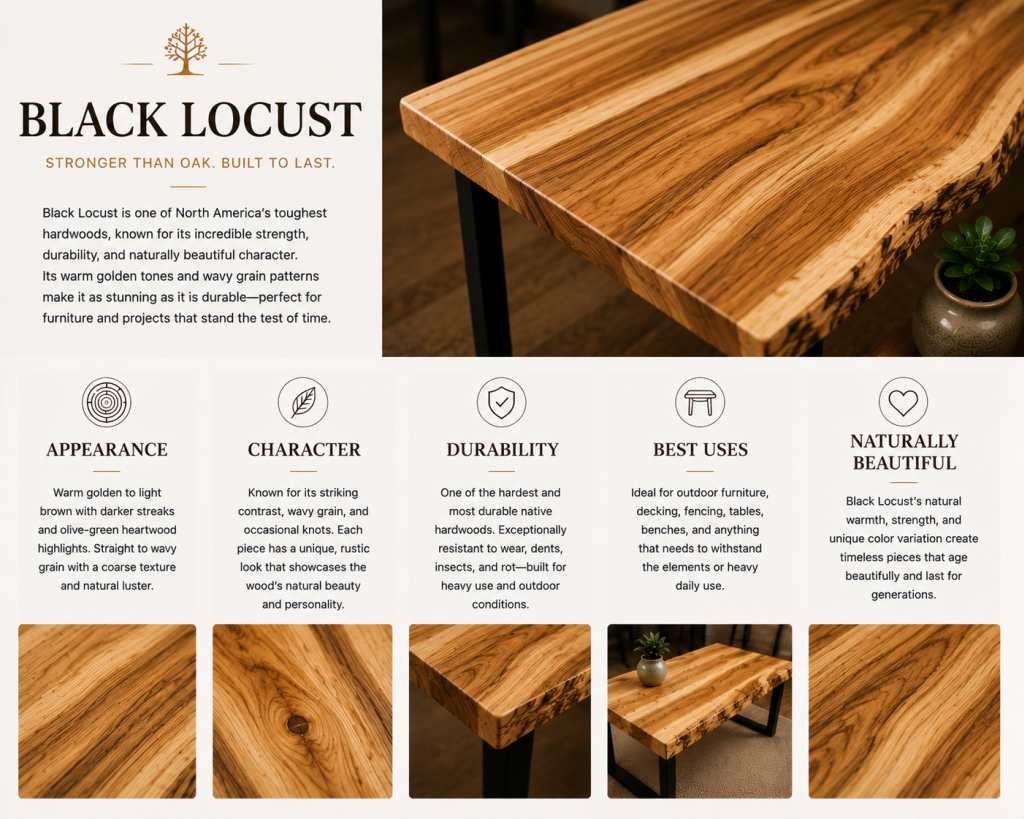
Black Locust is an exceptionally hard, strong, and naturally decay-resistant North American hardwood. Its warm golden-brown color, pronounced grain, and occasional darker streaks give it a distinctive appearance that can feel rustic, organic, or contemporary depending on the design.
For furniture buyers, Black Locust offers an unusual combination: the durability needed for demanding everyday use and the visual character expected from a one-of-a-kind piece. It is especially worth considering for live-edge furniture, tables, benches, and selected outdoor applications.
Black Locust at a Glance
Color: Golden yellow to medium brown, sometimes with olive, greenish, or darker brown streaks
Grain: Usually straight, with occasional irregular or interlocked areas
Distinctive features: Strong color variation, visible growth patterns, knots, and occasional live-edge character
Hardness: Exceptionally hard for a domestic hardwood
Durability: Highly resistant to wear and naturally resistant to decay
Best uses: Tables, benches, outdoor furniture, shelving, accent pieces, and other high-use furniture
Finish approach: Clear or lightly toned finishes can preserve the wood’s natural warmth and grain
Suitability: Excellent for indoor furniture and one of the stronger domestic options for properly designed outdoor pieces
What Makes Black Locust Distinctive?
Black Locust, or Robinia pseudoacacia, is a true wood species and should not be confused with Honey Locust. Although the two trees share part of their common name, they produce wood with different colors, properties, and visual character.
Black Locust is known for being remarkably hard, strong, and resistant to decay. It has traditionally been used wherever long-term durability matters, including fence posts, structural components, boatbuilding applications, and outdoor construction. Those same properties can make it an appealing choice for furniture intended to withstand years of regular use.
Its strength is only part of the story. Carefully selected Black Locust lumber can display rich golden tones, flowing grain, dark streaks, knots, and natural edge details. Rather than looking uniform or manufactured, it often has an honest, expressive quality that makes each board noticeably different.
Appearance and Character
Freshly milled Black Locust heartwood may range from pale golden yellow to yellowish brown. Some boards contain olive, greenish, or deeper brown areas that create striking natural contrast. The lighter sapwood can provide an additional color break when it is intentionally incorporated into a furniture design.
The grain is often straight, although individual boards may contain waves, curves, knots, or irregular patterns. These features are especially noticeable in wide tabletops and live-edge slabs, where more of the tree’s natural growth can be preserved.
With age and exposure to light, Black Locust generally develops a warmer, deeper brown appearance. A clear finish can emphasize this natural transformation while allowing the grain and color variation to remain visible.
Depending on board selection and the furniture’s design, Black Locust can complement several styles:
- Live-edge and organic furniture
- Rustic and farmhouse interiors
- Craftsman-inspired pieces
- Industrial wood-and-metal designs
- Clean-lined contemporary furniture
- Outdoor and garden settings
Natural variation is part of Black Locust’s appeal. No two boards will contain exactly the same combination of color, grain, knots, or edge character.
Working With Black Locust
Black Locust’s density and hardness demand careful material preparation. It can be more challenging to machine than softer domestic hardwoods, and dull tools may tear or burn the surface rather than cutting it cleanly.
Properly dried lumber is particularly important. A maker must evaluate each board for moisture content, grain direction, checking, knots, and movement before deciding how it should be used. Predrilling may also be advisable for screws and other fasteners because the wood’s hardness can make fastening difficult and increase the risk of splitting.
Board arrangement plays an important role in the final appearance. A tabletop can be composed to emphasize consistent golden coloring, dramatic contrast, flowing grain, or a more rustic mixture of natural features.
Black Locust generally accepts finishes well when the surface is prepared properly. For interior furniture, a clear or lightly toned finish can protect the wood while preserving its warmth and natural variation. Outdoor finishing choices require a different approach because sunlight and weather exposure will affect both appearance and maintenance needs.
Durability and Everyday Use
Black Locust is one of the hardest and most durable commonly discussed North American hardwoods. Its approximate Janka hardness rating of 1,700 pounds-force places it above familiar furniture woods such as White Oak, Hard Maple, and Black Walnut in resistance to indentation.
For homeowners, that hardness can mean better resistance to dents and everyday wear. It does not make a tabletop completely scratchproof, however. Abrasive objects, impacts, heat, standing water, and improper cleaning can still damage the wood or its finish.
Black Locust is also notable for its natural resistance to decay, including a history of use in demanding exterior and ground-contact applications. That makes it a strong candidate for outdoor furniture, but successful outdoor performance still depends on good construction, water-shedding details, suitable hardware, and realistic maintenance expectations.
Outdoor Black Locust that is allowed to weather naturally may gradually develop a silvery-gray surface. A protective finish can help retain more of its original color, but exterior finishes require periodic inspection and renewal.
Best Uses for Black Locust
Black Locust is particularly well suited to furniture that benefits from strength, durability, and expressive natural character.
Potential applications include:
- Dining and kitchen tables
- Coffee and console tables
- Live-edge tables
- Entryway and mudroom benches
- Outdoor benches and tables
- Garden furniture
- Shelving and display ledges
- Accent tables
- Wood-and-metal furniture
- Turned components and decorative objects
Its density can make very large pieces noticeably heavy. The finished dimensions, base design, installation location, and expected movement of the furniture should therefore be considered early in the design process.
Is Black Locust Right for Your Furniture?
Black Locust may be a good choice if you want:
- A very hard and durable domestic hardwood
- Warm golden-brown coloring
- Bold grain and natural variation
- Live-edge or organic character
- Wood suitable for demanding everyday use
- A potential option for carefully constructed outdoor furniture
- A less commonly seen alternative to oak, maple, or walnut
Another species may be preferable if you want extremely uniform color, subtle grain, very wide clear boards, or a lightweight finished piece. Black Locust lumber can also be less consistently available than common furniture hardwoods, so the project may need to be designed around the best material that can be sourced.
For buyers who like Black Locust’s durability but prefer a more familiar appearance, White Oak may be worth considering. Walnut may be a better fit when deep chocolate-brown color is the priority, while Ambrosia Maple offers a lighter background with more dramatic streaking and figure.
The Troon Woodshop Perspective
Black Locust is most successful when its natural variation is treated as part of the design rather than something that needs to be hidden.
For a custom tabletop, board selection would involve more than matching dimensions. The color transitions, grain flow, knots, natural edges, and darker streaks should be arranged so the surface feels intentional and visually balanced. A restrained base can allow a dramatic top to become the centerpiece, while steel elements can complement the strength and organic character of the wood.
Because every Black Locust board is different, the actual lumber should help guide the final design. That relationship between material and form is one of the advantages of commissioning custom furniture.
Interested in Custom Black Locust Furniture?
If you are considering a Black Locust table, bench, outdoor piece, or another custom furniture project, Troon Woodshop can help evaluate whether the species fits your design, intended use, and preferred appearance.
Every custom project begins with a conversation about dimensions, function, wood character, finish, and the setting where the finished piece will be used.