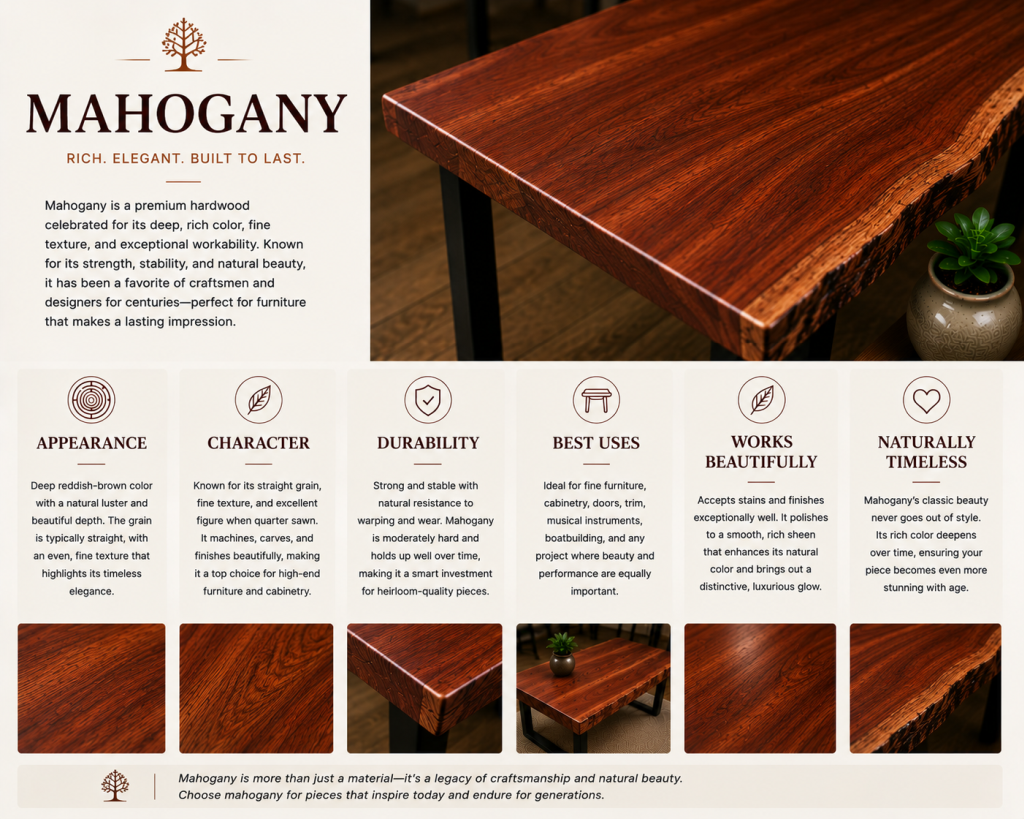
Mahogany is celebrated for its warm reddish-brown color, fine texture, dimensional stability, and long history in fine furniture and cabinetry. Its understated grain and natural luster can produce furniture that feels rich and elegant without depending on dramatic figure or heavy ornamentation.
However, mahogany is not always a single, clearly identified wood. Genuine mahogany belongs to the Swietenia genus, while African Mahogany belongs to the related Khaya genus. Several unrelated woods are also sold using “mahogany” as part of their trade name. The exact species and source should therefore be confirmed before selecting lumber for a custom project.
Mahogany Wood at a Glance
Color: Pale pinkish brown to medium or deep reddish brown
Grain: Usually straight, but sometimes interlocked, wavy, or figured
Distinctive features: Fine to medium texture, natural luster, ribbon stripe, curl, and color that deepens with age
Visual character: Warm, refined, classic, and quietly luxurious
Hardness: Moderate, with meaningful variation among species
Durability: Generally stable and dependable, but natural decay resistance varies
Best uses: Fine furniture, cabinetry, desks, tables, doors, trim, musical instruments, and decorative accents
Finish approach: Clear or lightly toned finishes can emphasize depth, color, and natural luster
Suitability: Excellent for indoor furniture; outdoor suitability depends on the exact species, construction, finish, and exposure
What Makes Mahogany Distinctive?
True or genuine mahogany refers to species in the Swietenia genus, including Bigleaf Mahogany, or Swietenia macrophylla. These woods are native to tropical regions of the Americas and have a long history in furniture, cabinetry, architectural woodwork, boatbuilding, and musical instruments.
African Mahogany refers to several species in the Khaya genus. These related woods can offer a similar reddish-brown appearance and many of the working qualities associated with genuine mahogany, but color, density, grain, stability, and durability can vary among species and individual boards.
Other names can create confusion. Philippine Mahogany, for example, commonly refers to woods in the Shorea genus and is not genuine mahogany. Sapele is another reddish-brown African hardwood that is sometimes compared with mahogany, but it is a distinct species with its own grain, hardness, and working characteristics.
This does not mean that only genuine mahogany can produce beautiful furniture. It means that the actual species should be identified rather than relying on the word “mahogany” alone.
Appearance and Character
Mahogany heartwood can range from a relatively light pinkish or yellowish brown to a deeper red-brown. Freshly surfaced lumber may appear lighter than expected, with its warmer color developing through exposure to air and light.
The grain is often straight and even, giving the wood a composed and refined appearance. Interlocked grain can produce ribbon-like figure, especially on quartersawn surfaces. Other boards may display curl, waves, stripes, or changes in luster as the viewing angle shifts.
Natural characteristics may include:
- Subtle color differences between boards
- Straight or interlocked grain
- Ribbon stripe on quartersawn surfaces
- Curly or wavy figure
- Darker streaks
- Pores and fine texture variations
- Lighter sapwood near an edge
Mahogany works comfortably in traditional furniture, but it should not be limited to formal or historic designs. Clean lines and simple joinery can give it a contemporary character, while a natural edge or metal base can produce a warmer industrial or organic piece.
Its visual depth makes it suitable for:
- Traditional and formal interiors
- Craftsman-inspired furniture
- Mid-century modern designs
- Contemporary furniture
- Campaign-style furniture
- Nautical and maritime-inspired pieces
- Wood-and-metal designs
- Refined live-edge furniture
Working With Mahogany
Mahogany earned much of its reputation through its favorable working qualities. Genuine Mahogany is generally known for machining cleanly, holding details, accepting joinery, and remaining relatively stable after proper drying.
Those qualities should still be evaluated board by board. African Mahogany may contain interlocked grain that can tear during machining if tool direction and cutting technique are not carefully managed. Density and working behavior can also vary because lumber sold as African Mahogany may come from different Khaya species.
Material selection should consider:
- Exact species or commercial grouping
- Documented source
- Moisture content
- Grain direction
- Heartwood and sapwood balance
- Color consistency
- Interlocked or figured grain
- Intended use of the finished piece
Mahogany generally accepts finishes well and can be polished to a smooth, rich surface. Clear finishes emphasize its natural depth and changing color. A lightly toned finish can help unify boards when appropriate, but an overly dark stain may obscure the subtle grain and luster that make the wood distinctive.
Open pores may remain visible under a natural finish. For furniture requiring an especially smooth, formal surface, a pore-filling finishing schedule may be used. For a more natural or contemporary piece, allowing some texture to remain visible can preserve more of the wood’s character.
Durability and Everyday Use
Mahogany is commonly described as stable, meaning properly dried boards tend to respond reasonably well to normal indoor humidity changes. That stability is valuable for tables, cabinets, doors, drawers, and furniture with fitted components.
Its surface hardness is generally moderate rather than extreme. Mahogany can withstand normal household use, but it is not as resistant to dents as especially hard woods such as Black Locust or Hard Maple. A well-chosen finish offers protection from routine spills and wear without making the surface impervious to damage.
Homeowners should still:
- Wipe up spills promptly
- Use coasters and trivets
- Avoid placing very hot objects directly on the finish
- Lift rather than drag decorative items
- Avoid abrasive or harsh chemical cleaners
- Maintain reasonably stable indoor humidity
- Protect the furniture from excessive direct sunlight
Some mahogany species have a history of marine or exterior use, but “mahogany” alone does not guarantee outdoor durability. The exact species, heartwood content, joinery, drainage, hardware, finish, and exposure conditions all affect exterior performance.
Best Uses for Mahogany
Mahogany is especially effective when a design calls for warm color, visual depth, stability, and a refined surface.
Potential uses include:
- Dining tables
- Desks and writing tables
- Coffee and console tables
- Side tables and nightstands
- Cabinets and built-ins
- Dressers and chests
- Beds and headboards
- Chairs and benches
- Doors and architectural trim
- Decorative boxes
- Musical-instrument components
- Nautical-inspired furnishings
- Select outdoor or covered furniture when the exact material is suitable
The species can support both subtle and expressive designs. Straight-grained boards create a calm, unified surface, while figured or quartersawn material can become a prominent design feature.
Is Mahogany Right for Your Furniture?
Mahogany may be a good choice if you want:
- Warm reddish-brown coloring
- Fine to medium texture
- A classic furniture wood with broad design flexibility
- Good stability for indoor furniture
- A surface capable of taking a refined finish
- Grain that can range from quiet to strongly figured
- Furniture that becomes richer in appearance with age
Another wood may be preferable if you want pale coloring, extremely high dent resistance, bold open grain, or locally sourced North American lumber.
Cherry offers a warm reddish appearance with a more distinctly domestic furniture tradition. Walnut provides naturally dark chocolate-brown color. Sapele can offer stronger ribbon figure and somewhat greater hardness, while White Oak provides more visible grain and better resistance to everyday denting.
Availability, price, species identity, and sourcing documentation should all be considered before making the final selection.
Responsible Mahogany Selection
Mahogany’s history includes serious concerns related to overharvesting and illegal logging. Bigleaf Mahogany is regulated under Appendix II of the Convention on International Trade in Endangered Species of Wild Fauna and Flora.
Appendix II does not mean that all trade in the species is prohibited. It means regulated international trade requires documentation intended to verify legal acquisition and prevent trade from threatening the species’ survival.
For a custom project, “mahogany” should not be accepted as a complete material description. A responsible selection process should seek:
- The botanical or clearly defined commercial species
- Country or region of origin when available
- Documentation from a reputable supplier
- Confirmation that regulated wood entered trade legally
- Plantation-grown or independently certified material when appropriate and available
- A quantity appropriate to the project rather than unnecessary excess
Responsible sourcing is not only an environmental consideration. Knowing the actual material also helps predict its color, grain, workability, stability, and long-term performance.
The Troon Woodshop Perspective
A successful Mahogany project begins with identifying the lumber accurately. Two boards sold under similar names may differ noticeably in color, density, grain, and working behavior.
For a tabletop, the boards should be composed for both color and grain flow. Straight-grained material can create a quiet, formal surface, while ribbon stripe or curl may be reserved for areas where the figure can be appreciated. Lighter sapwood can be minimized for a traditional appearance or incorporated intentionally into a more contemporary design.
The base and hardware also influence how the wood is perceived. A traditional wood base reinforces Mahogany’s classic character. Clean steel legs or a restrained contemporary base can make the same material feel modern and architectural.
The goal is to let the wood’s warmth and depth carry the design while ensuring that the species, source, and construction are appropriate for the finished furniture.
Interested in Custom Mahogany Furniture?
If you are considering a Mahogany dining table, desk, cabinet, side table, or another custom furniture project, Troon Woodshop can help evaluate the available material and determine whether it suits the design and intended use.
The conversation should include the exact wood being considered, its appearance and source, the furniture’s dimensions, the desired finish, and the setting where the completed piece will be used.